
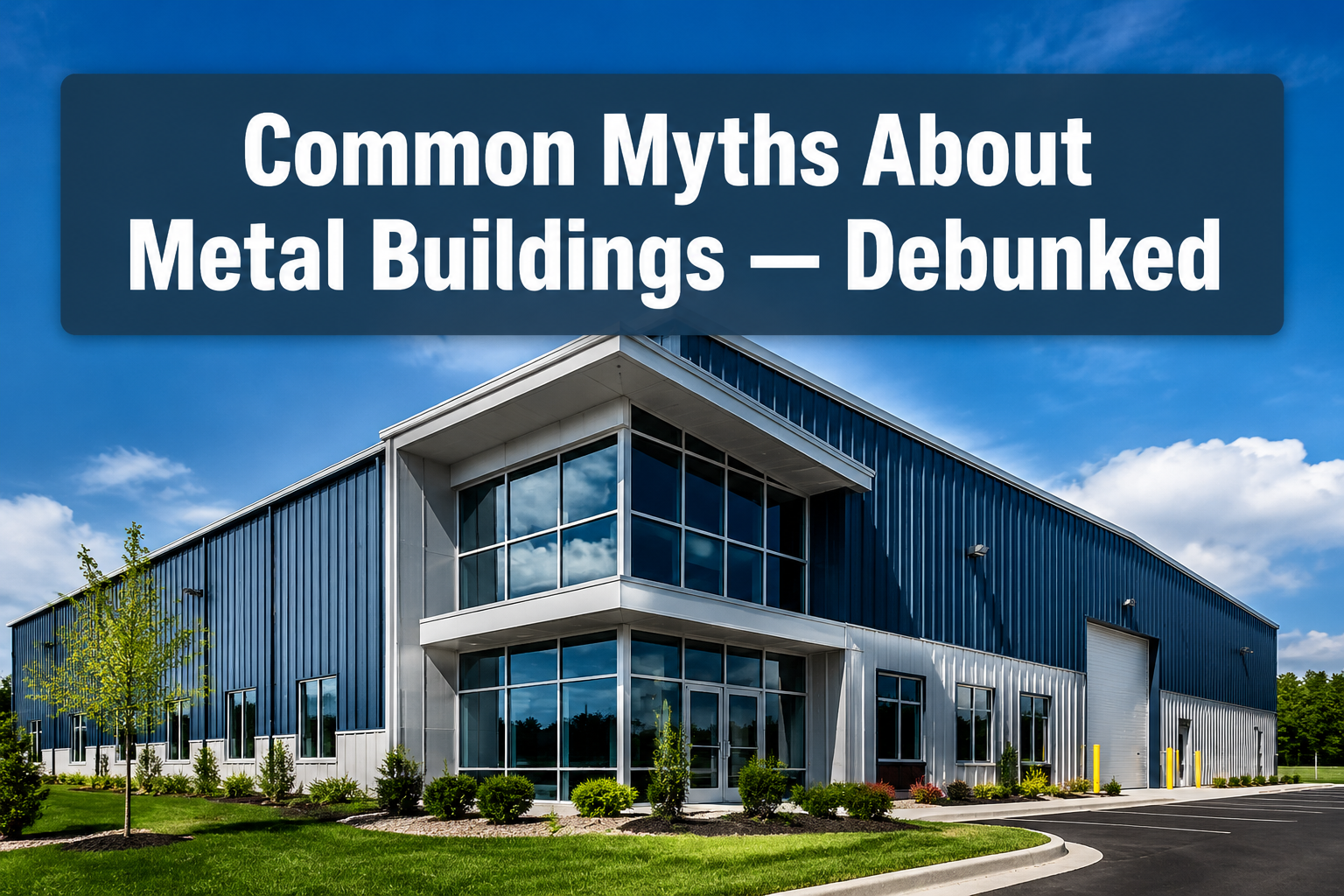
Last updated: May 18, 2026
Quick Answer: Most common myths about metal buildings stem from outdated perceptions formed decades ago, before modern steel construction technology matured. Today’s metal buildings are energy-efficient, durable, customizable, and suitable for residential, commercial, and agricultural use. The myths do not reflect current materials, engineering standards, or building codes.
Key Takeaways
- Metal buildings do not rust easily when built with modern galvanized or Galvalume-coated steel.
- Steel structures can be highly energy-efficient with proper insulation systems.
- Metal buildings are not limited to warehouses — they serve as homes, offices, churches, and retail spaces.
- A steel building is not automatically cheaper to build, but it typically offers lower lifetime costs than wood-frame construction.
- Metal roofs are not significantly louder than other roofing types when insulated correctly.
- Steel buildings can be designed to look like traditional brick, wood, or stone structures.
- Metal buildings are engineered to withstand high winds, heavy snow loads, and seismic activity.
- Financing and insurance for metal buildings are widely available through mainstream lenders and insurers.
- Building permits for metal structures follow the same codes as conventional construction in most jurisdictions.
- The resale value of metal buildings has improved significantly as the market has matured.
Why Do So Many Common Myths About Metal Buildings Persist?
Many of the common myths about metal buildings trace back to the mid-20th century, when prefabricated steel structures were largely utilitarian — think corrugated tin sheds and basic agricultural storage. Those early designs were not insulated, not aesthetically refined, and not engineered for comfort. The reputation stuck even as the industry moved far beyond those origins.
A contractor I spoke with at a regional building expo described it well: “I still get clients who walk in expecting a tin can. Then I show them photos of steel-frame homes with stone facades and open floor plans, and their jaws drop. The gap between perception and reality is enormous.”
Understanding where these myths come from helps explain why they’re so persistent — and why debunking them requires more than a quick reassurance.
Myth #1: Metal Buildings Always Rust and Deteriorate Quickly
Metal buildings built with modern coated steel do not rust under normal conditions. The steel used in today’s commercial and residential metal buildings is treated with zinc (galvanization) or a zinc-aluminum alloy coating called Galvalume, which creates a protective barrier against oxidation. When properly maintained, these coatings can last 40 to 60 years or more.
What Actually Causes Corrosion
Corrosion becomes a concern only under specific conditions:
- Prolonged exposure to standing water without drainage
- Coastal environments with high salt-air concentration (which requires marine-grade coatings)
- Physical damage to the protective coating that is left unrepaired
- Use of dissimilar metals in contact without proper isolation
Choose a Galvalume-coated steel system if your building will be in a humid or coastal environment. For inland, low-humidity regions, standard galvanized steel performs exceptionally well.
“The rust myth is the one I hear most often. Modern steel buildings are coated, painted, and sealed in ways that make them more corrosion-resistant than exposed iron or untreated steel from 50 years ago.” — Common observation among steel building contractors
Myth #2: Metal Buildings Are Only for Warehouses and Industrial Use
Steel-frame construction is used across virtually every building category, including single-family homes, multi-family housing, churches, retail centers, schools, and medical clinics. The flexibility of steel framing allows architects to design open floor plans, large clear-span interiors, and custom exterior finishes that closely resemble wood, brick, or stone.
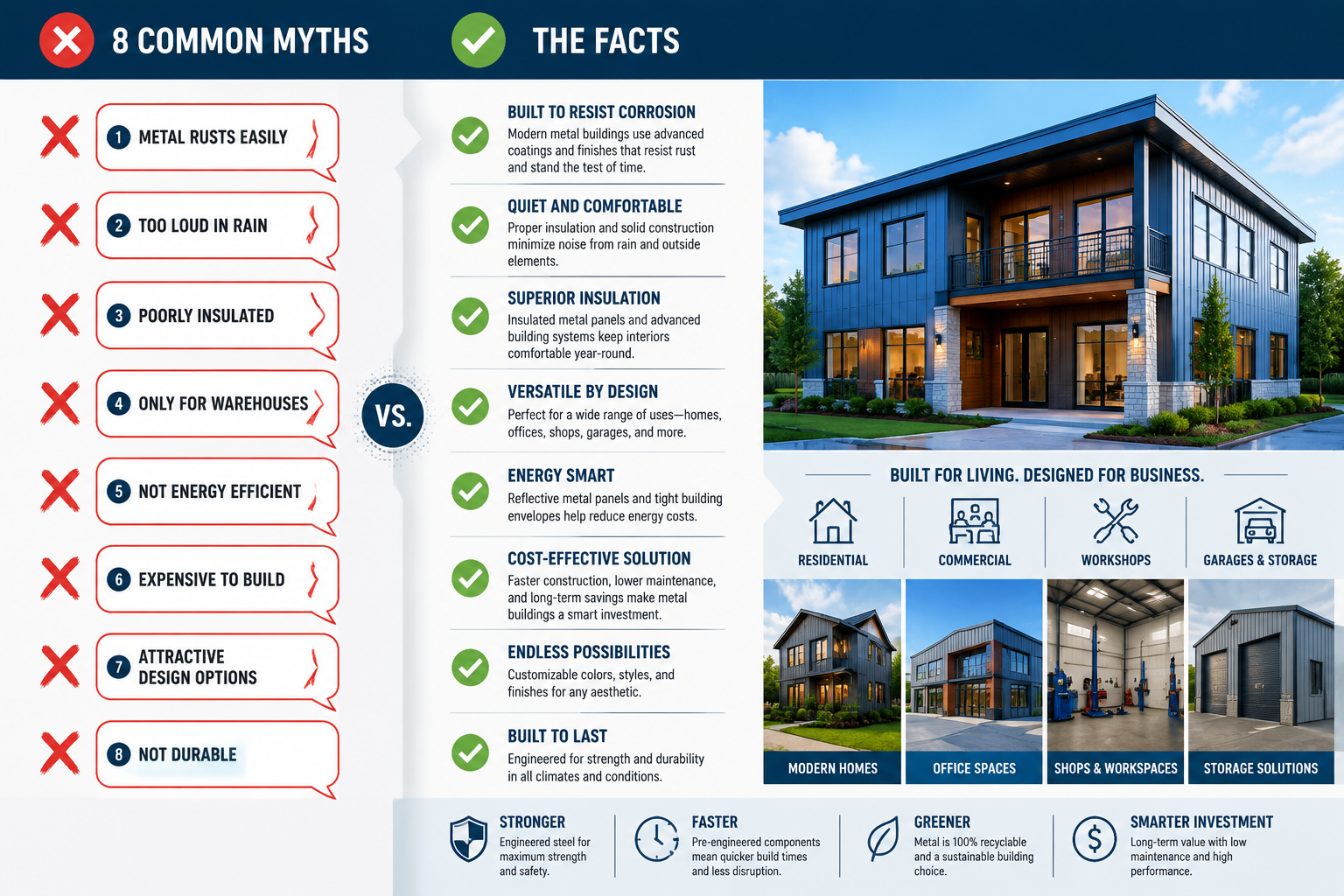
Examples of Non-Industrial Metal Building Uses
| Use Category | Common Application |
|---|---|
| Residential | Barndominium homes, custom steel-frame houses |
| Commercial | Retail shops, auto dealerships, restaurants |
| Agricultural | Barns, equipment storage, livestock facilities |
| Institutional | Schools, community centers, fire stations |
| Religious | Churches, mosques, worship centers |
| Recreation | Sports complexes, equestrian arenas, gyms |
The barndominium trend — a steel-frame structure combining living quarters with workshop or garage space — has grown substantially in rural and semi-rural markets. These buildings are fully insulated, climate-controlled, and finished to residential standards.
Choose a metal building for residential use if you want large open spans, faster construction timelines, and lower long-term maintenance compared to wood-frame construction.
Myth #3: Metal Buildings Are Extremely Loud During Rain or Hail
A properly insulated metal building is not noticeably louder than a wood-frame building during rain. The noise concern applies almost exclusively to uninsulated metal roofs — the kind found on old agricultural sheds. When a metal roof system includes a layer of rigid foam, spray foam, or batt insulation, the acoustic dampening effect is significant.
How Insulation Reduces Noise
- Spray polyurethane foam (SPF): Applied directly to the underside of the roof panels, it eliminates the air gap that amplifies sound.
- Rigid board insulation: Installed between the roof purlins and the interior liner panel, it creates a thermal and acoustic barrier.
- Batt insulation with vapor barrier: A cost-effective option that reduces noise transmission by 60–70% compared to an uninsulated roof (estimate based on standard acoustic dampening principles for fibrous insulation).
If noise is a concern for your specific use — a recording studio, a medical office, or a school — specify an acoustic insulation package in your building contract. This is a solvable engineering problem, not an inherent flaw of steel construction.
Myth #4: Metal Buildings Are Always the Cheapest Option
Metal buildings are not automatically the lowest-cost construction method, and treating them as a budget shortcut often leads to disappointment. The raw material cost of steel fluctuates with commodity markets. In years when steel prices spike, a prefabricated metal building kit may cost more per square foot than a comparable wood-frame structure.
Where Metal Buildings Save Money (and Where They Don’t)
Lower costs:
- Faster erection time reduces labor costs
- Fewer structural columns in clear-span designs reduce interior finish complexity
- Lower long-term maintenance costs (no wood rot, termites, or mold)
- Potential insurance premium reductions due to fire resistance
Higher costs:
- Foundation work is similar to or greater than wood-frame construction
- Interior finishing (drywall, electrical, plumbing) costs are comparable
- Customization and architectural detailing add cost
- Steel price volatility can increase material costs unpredictably
The better framing: Metal buildings often have a lower lifetime cost, not necessarily a lower upfront cost. A 40-year cost-of-ownership comparison frequently favors steel, but the initial construction budget may be similar to or slightly above wood-frame alternatives.
Myth #5: Metal Buildings Are Not Energy Efficient
Modern metal buildings can meet or exceed energy efficiency standards required by commercial and residential building codes. The key variable is the insulation system, not the steel itself. Steel is a thermal conductor, which means an uninsulated steel wall or roof will transfer heat readily — but this is addressed through thermal break systems and high-R-value insulation packages.
Energy Efficiency Strategies for Metal Buildings
- Thermal break framing: Insulating strips placed between the steel frame and exterior panels interrupt the conductive path.
- High-R insulation systems: Spray foam or multi-layer batt systems achieve R-19 to R-38 in walls and R-30 to R-49 in roofs, meeting or exceeding IECC (International Energy Conservation Code) requirements.
- Reflective roof coatings: Cool-roof coatings reduce solar heat gain, lowering cooling loads in warm climates.
- Tight building envelope: Metal panel systems, when properly sealed, produce fewer air infiltration points than wood-frame construction with multiple penetrations.
The Metal Building Manufacturers Association (MBMA) has published energy efficiency guidelines that align with ASHRAE 90.1 standards, the benchmark used by most commercial energy codes in the United States.
Myth #6: Metal Buildings Cannot Withstand Severe Weather
Steel-frame buildings are engineered to meet or exceed local wind, snow, and seismic load requirements set by building codes. In fact, metal buildings are frequently specified for use in hurricane-prone and tornado-risk regions precisely because of their structural performance under lateral and uplift loads.
Weather Performance by Hazard Type
- High winds: Steel frames are designed to resist wind loads per ASCE 7 (American Society of Civil Engineers standard). Many metal buildings are rated for 130–150 mph wind exposure.
- Snow loads: Roof systems are engineered for the ground snow load of the specific geographic location, with safety factors built in.
- Seismic activity: Steel’s ductility — its ability to flex without fracturing — makes it one of the preferred structural materials in earthquake zones.
- Fire resistance: Steel does not combust. While it loses structural strength at very high temperatures, it does not contribute to fire spread the way wood framing does.
Common mistake: Assuming that a metal skin equals a metal structure. Some buildings have metal cladding over wood or light-gauge steel framing, which has different performance characteristics than a full structural steel frame. Verify the structural system, not just the exterior material.
Myth #7: Metal Buildings Look Industrial and Cannot Be Customized
The exterior appearance of a metal building is almost entirely a design choice, not a structural constraint. Modern metal building systems offer a wide range of cladding options, including:
- Brick or stone veneer: Applied over the steel frame to create a traditional masonry appearance
- Stucco finishes: Common in commercial and residential applications in the Southwest
- Wood-look metal panels: Textured and painted to replicate timber siding
- Glass curtain walls: Frequently used in commercial and institutional metal buildings
- Standing seam metal roofing: Available in dozens of colors and profiles
Roof pitches, overhangs, dormers, cupolas, and architectural trim are all achievable within a steel-frame system. Many custom homes built on steel frames are indistinguishable from wood-frame construction from the exterior.
Addressing the Most Persistent Common Myths About Metal Buildings
Beyond the individual myths above, a cluster of secondary misconceptions continues to circulate — particularly around financing, permits, and resale value. These deserve direct answers.
“Banks Won’t Finance Metal Buildings”
This was more accurate 20–30 years ago. Today, conventional mortgage lenders, USDA rural development loans, and SBA commercial loans all accommodate metal building construction and purchase. The key requirement is that the building meets local building codes and has a proper foundation — the same standard applied to any structure.
“Metal Buildings Are Hard to Get Permits For”
Metal building systems from reputable manufacturers are designed to comply with the International Building Code (IBC) and International Residential Code (IRC). Engineered drawings are typically included with the building package, which simplifies the permit application process. In most jurisdictions, permitting a metal building is no more complex than permitting a wood-frame structure of equivalent size.
“Metal Buildings Have Poor Resale Value”
Resale value depends on location, condition, use, and market demand — the same factors that affect any property. Well-maintained metal commercial buildings in strong markets sell at competitive cap rates. Residential metal buildings (barndominiums, steel-frame homes) have seen growing buyer demand, particularly in rural markets, as of 2026.
FAQ: Common Questions About Metal Building Myths
Q: Do metal buildings attract lightning?
A: No more than any other tall structure. Metal buildings are grounded through their foundation and framing system, which actually provides a safer path for lightning discharge than ungrounded wood structures. Proper grounding is part of standard electrical installation.
Q: Are metal buildings safe in a tornado?
A: A properly engineered steel building performs better than light wood-frame construction in high-wind events. However, no above-ground structure provides complete protection from a direct tornado strike. Underground shelters remain the safest option for extreme tornado scenarios.
Q: Will a metal building make my property harder to insure?
A: Generally, the opposite is true. Metal buildings are fire-resistant and less susceptible to termite or rot damage, which can result in lower insurance premiums compared to wood-frame structures. Contact your insurer for specific quotes.
Q: How long does it take to construct a metal building?
A: A prefabricated metal building erects faster than comparable wood-frame construction. A simple commercial structure of 5,000 square feet can be erected in one to three weeks once the foundation is in place. Total project timelines vary based on permitting, foundation work, and interior finishing.
Q: Can I expand a metal building later?
A: Yes. One of the practical advantages of steel-frame construction is that expansion is relatively straightforward. End walls can be removed and the building extended along its length without compromising the structural integrity of the original frame.
Q: Are metal buildings environmentally friendly?
A: Steel is one of the most recycled materials in the world. According to the American Iron and Steel Institute (AISI), steel has a recycling rate above 80% in North America. Metal buildings can also be disassembled and relocated, reducing demolition waste.
Q: Do metal buildings get too hot in summer?
A: Without insulation and ventilation, yes. With proper insulation, reflective roof coatings, and HVAC systems, metal buildings maintain comfortable interior temperatures comparable to any other construction type.
Q: Is it true that metal buildings are only practical in rural areas?
A: No. Metal-frame construction is used extensively in urban commercial, industrial, and mixed-use developments. Zoning restrictions in some municipalities may limit certain metal building aesthetics, but the structural system itself is permitted in most urban zones.
Q: Can metal buildings be built to residential code?
A: Yes. Steel-frame homes are built to IRC standards in most U.S. states. The framing material is different, but the code compliance process is the same.
Q: How do metal buildings perform in cold climates?
A: With adequate insulation and a vapor barrier, metal buildings perform well in cold climates. The thermal bridge issue (steel conducting cold from exterior to interior) is addressed through thermal break systems and continuous insulation layers.
Conclusion: What to Do With This Information
The common myths about metal buildings have persisted largely because the industry changed faster than public perception. Steel construction technology has advanced considerably over the past 30 years, and the buildings being delivered today bear little resemblance to the corrugated tin structures that shaped the original reputation.
Here are practical next steps if you’re evaluating a metal building:
- Request engineered drawings from any manufacturer you’re considering. A reputable supplier will provide stamped drawings that meet your local building code.
- Get a full lifecycle cost estimate, not just a construction quote. Include maintenance, energy, and insurance costs over 20–30 years.
- Visit completed projects in your region. Seeing finished metal buildings — residential, commercial, or agricultural — eliminates most aesthetic concerns immediately.
- Consult your local building department early to understand permit requirements specific to your jurisdiction.
- Work with an experienced metal building contractor, not a general contractor who is unfamiliar with steel erection. The installation quality matters as much as the building system itself.
Metal buildings are not the right choice for every project, but the reasons to avoid them should be based on real project requirements — not on myths that no longer reflect how these structures are built or how they perform.
References
- American Iron and Steel Institute (AISI). Steel Recycling Rates and Data. Washington, D.C.: AISI. https://www.steel.org
- Metal Building Manufacturers Association (MBMA). Energy Design Guide for Metal Building Systems. Cleveland, OH: MBMA, 2012. https://www.mbma.com
- American Society of Civil Engineers. ASCE 7: Minimum Design Loads and Associated Criteria for Buildings and Other Structures. Reston, VA: ASCE, 2022. https://www.asce.org
- International Code Council. International Building Code (IBC). Country Club Hills, IL: ICC, 2021. https://www.iccsafe.org
- U.S. Department of Agriculture Rural Development. Single Family Housing Guaranteed Loan Program. Washington, D.C.: USDA, 2023. https://www.rd.usda.gov