
Last updated: May 20, 2026
Quick Answer
Condensation problems in metal buildings occur when warm, moisture-laden air contacts cold metal surfaces and water vapor turns into liquid. Left unaddressed, this moisture causes rust, mold, structural damage, and ruined inventory. The most effective solutions combine proper insulation, vapor barriers, and mechanical ventilation — and most problems can be prevented at the design stage for far less than the cost of remediation.
Key Takeaways
- Metal conducts heat and cold far more efficiently than wood, making it highly susceptible to condensation when interior and exterior temperatures differ.
- The dew point — the temperature at which air can no longer hold its moisture — is the core concept behind every condensation problem in a metal structure.
- Spray foam insulation and faced fiberglass batts are the two most commonly recommended insulation types for metal buildings, each suited to different budgets and climates.
- A vapor barrier (or vapor retarder) is not optional in humid or cold climates; it is a foundational moisture-control layer.
- Agricultural metal buildings face unique condensation challenges because of animal respiration, wet feed, and manure — all of which dramatically raise interior humidity.
- Ignoring condensation leads to corrosion, compromised structural fasteners, mold growth, and potential liability — repair costs can run 10 to 50 times higher than prevention costs (estimated based on typical contractor quotes for structural remediation vs. initial insulation installation).
- Most minor condensation issues can be addressed by a skilled DIYer; serious structural moisture damage requires a licensed contractor or building envelope specialist.
- Climate matters: cold climates generate condensation on interior surfaces; hot, humid climates can reverse the gradient and push moisture inward from outside.
What Causes Condensation in Metal Buildings?
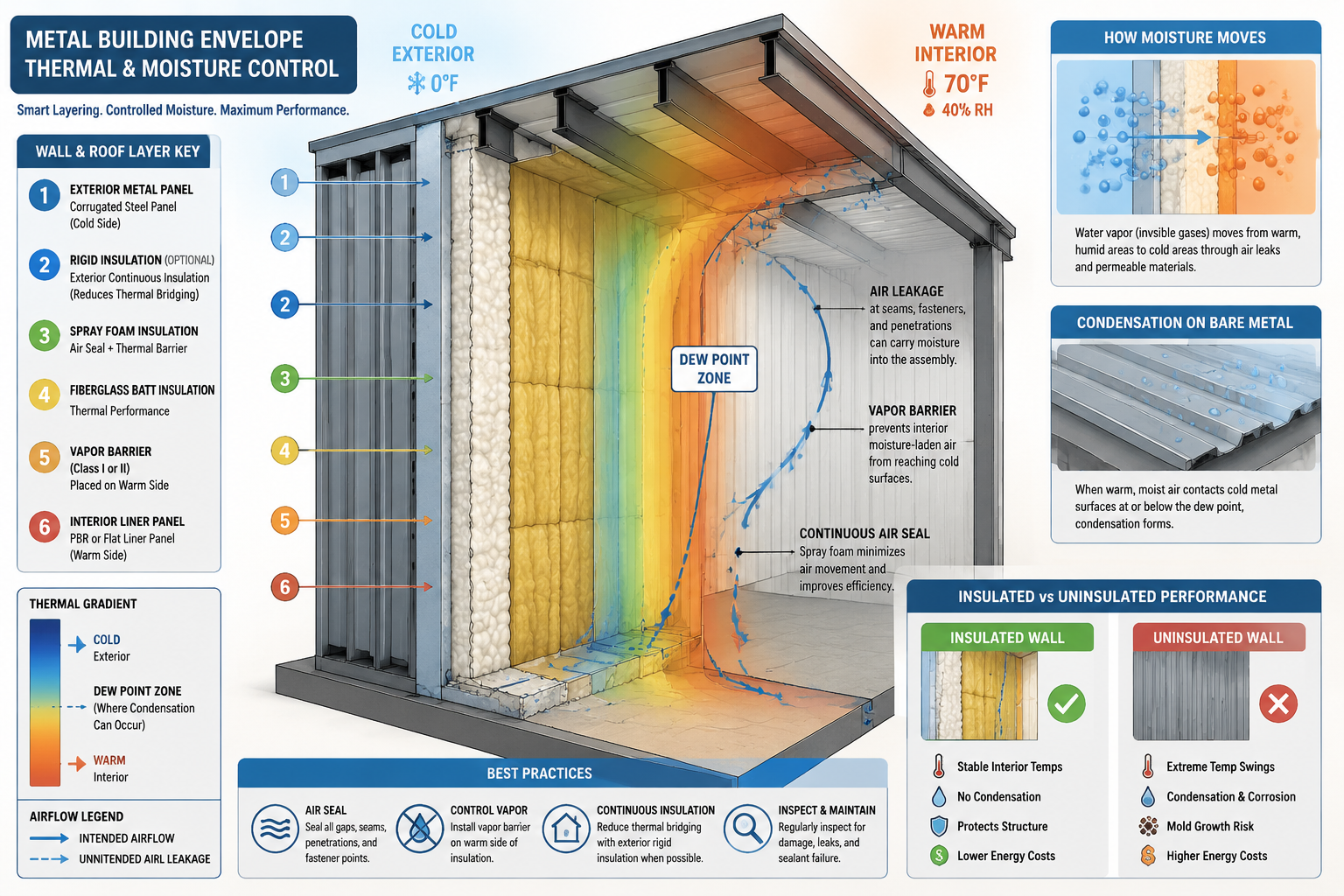
Condensation forms when warm, humid air meets a surface that is at or below the dew point temperature. In metal buildings, this happens constantly because steel and aluminum are excellent thermal conductors — they transfer heat (and cold) almost instantly, unlike wood or concrete.
Here is the basic physics: air holds water vapor up to a limit determined by its temperature. When that air touches a cold metal panel, the air near the surface cools rapidly. Once it drops to the dew point, it can no longer hold its moisture, and water appears on the metal surface.
The main contributing factors include:
- Temperature differential: A large gap between interior and exterior temperatures accelerates condensation. This is most dramatic in winter, but it also occurs in summer when air-conditioned interiors meet hot exterior panels.
- High interior humidity: Activities like washing equipment, storing wet materials, animal housing, or even human respiration raise indoor relative humidity significantly.
- Lack of insulation: Uninsulated metal panels reach outdoor temperatures almost immediately, making them condensation magnets whenever warm air is present inside.
- Poor ventilation: Stagnant, humid air has nowhere to go, so moisture accumulates on every cold surface it contacts.
- Thermal bridging: Metal purlins, girts, and framing members conduct cold from the exterior directly into the building envelope, creating localized cold spots even in otherwise-insulated structures.
Rule: “In an uninsulated metal building, the roof and walls are essentially giant cold plates waiting to collect moisture from any warm, humid air inside.”
Are Metal Buildings More Prone to Condensation Than Wood Structures?
Yes — metal buildings are significantly more prone to condensation than wood-framed structures, primarily because of thermal conductivity. Steel conducts heat roughly 300 to 400 times more efficiently than wood (a widely cited property in materials science), meaning metal surfaces reach ambient outdoor temperatures almost instantly while wood provides natural thermal resistance.
Wood also has some capacity to absorb and release moisture without immediate surface condensation. Metal has none. A wood-framed wall with fiberglass insulation has a much more gradual thermal gradient from inside to outside; a bare metal wall has almost none.
That said, metal buildings are not inherently inferior — they are simply less forgiving of poor moisture management. When properly insulated and ventilated, a metal building can perform as well as or better than wood construction, with the added benefits of longevity and fire resistance.
Choose metal construction if: you are willing to invest in proper insulation and vapor control from the start.
Reconsider bare metal construction if: your budget does not allow for insulation and you are in a high-humidity or cold climate.
What Are the Signs of Serious Condensation Damage?
Condensation damage is often visible before it becomes structural, which gives building owners a window to act. Catching it early is the difference between a few hundred dollars in materials and a five-figure repair bill.
Early warning signs:
- Water droplets or streaks on interior wall and roof panels, especially in the morning
- Rust stains running down walls from fastener locations
- A persistent musty or metallic smell inside the building
- Visible mold or mildew on insulation, stored goods, or wood components (floors, shelving, framing)
- Wet or damp insulation batts (faced insulation that feels heavy or sags)
- Frost on interior surfaces during cold weather
Signs of serious, advanced damage:
- Surface rust that has progressed to pitting or perforation of panels
- Fastener corrosion causing panels to loosen or rattle
- Rust streaking from roof ridge or eave trim
- Buckled or delaminating insulation
- Structural purlins or girts showing rust scale
- Standing water or persistent wet spots on the floor near walls
Common mistake: Many building owners assume condensation is “just a little moisture” and ignore it for seasons. Rust on a fastener can compromise panel attachment; rust on a structural member can affect load capacity. Do not wait for visible structural damage before acting.
How to Prevent Moisture Buildup in a Metal Warehouse or Building
Preventing condensation problems in metal buildings is far more cost-effective than treating them after the fact. Prevention works on three fronts: controlling the moisture source, blocking moisture movement through the envelope, and removing excess humidity through ventilation.
Step-by-step prevention framework:
- Assess your humidity sources. Identify what generates moisture inside — occupants, processes, stored materials, or outdoor air infiltration. Quantify the problem before specifying a solution.
- Install continuous insulation. Cover all metal surfaces, including purlins and girts, to eliminate thermal bridges. Spray foam directly applied to the metal is the most effective method for eliminating thermal bridging.
- Install a vapor barrier on the warm side of insulation. In cold climates, this is the interior side. In hot, humid climates, placement may shift — consult a building envelope engineer for your specific climate zone.
- Seal all penetrations. Electrical conduits, HVAC ducts, and pipe penetrations are common air leakage points. Use foam sealant or vapor-barrier tape at every penetration.
- Provide mechanical ventilation. Ridge vents, eave vents, and powered exhaust fans remove humid air before it can condense. Aim for a minimum of one air change per hour in high-humidity applications (estimate based on ASHRAE ventilation guidelines for commercial buildings).
- Control interior humidity directly. Dehumidifiers, HVAC systems with humidity control, and operational changes (like covering wet materials) all reduce the moisture load.
- Inspect annually. Check insulation condition, vapor barrier integrity, and fastener rust every year. Early intervention is inexpensive.
What Insulation Works Best to Reduce Moisture in Metal Buildings?
The best insulation for condensation control in a metal building depends on climate, budget, and building use. No single product is universally superior, but spray polyurethane foam (SPF) comes closest to a complete solution for most applications.
Comparison of common insulation types for metal buildings:
| Insulation Type | Condensation Control | R-Value per Inch | Vapor Barrier Needed? | Typical Installed Cost (est.) |
|---|---|---|---|---|
| Spray foam (closed-cell) | Excellent | ~6.5 | No (acts as barrier) | $1.50–$3.50/sq ft |
| Faced fiberglass batts | Good | ~3.2 | Facing acts as retarder | $0.50–$1.50/sq ft |
| Rigid foam board | Good | ~3.8–6.5 | Separate barrier needed | $0.75–$2.00/sq ft |
| Loose-fill / blown-in | Fair | ~2.5–3.8 | Separate barrier needed | $0.80–$2.00/sq ft |
| Reflective / radiant barrier | Poor (alone) | Varies | Separate barrier needed | $0.25–$0.75/sq ft |
Cost estimates are broad ranges based on 2025–2026 contractor pricing data and vary significantly by region, project size, and labor market.
Closed-cell spray foam bonds directly to metal, eliminates thermal bridging, and acts as its own vapor barrier. It is the most expensive option but requires no additional vapor barrier and leaves no air gaps where condensation can form.
Faced fiberglass batts (the “vinyl-backed” or “white-faced” insulation common in metal building packages) are cost-effective and widely available, but they must be installed without gaps or compression, and the facing must be on the warm side of the assembly.
Common mistake: Installing unfaced or improperly faced insulation, or leaving gaps at purlins and girts, creates cold spots that generate condensation even in otherwise-insulated buildings.
How Much Does It Cost to Install a Vapor Barrier in a Metal Building?
A standalone vapor barrier installation in a metal building typically costs between $0.15 and $0.50 per square foot for materials, with total installed costs (materials plus labor) ranging from $0.50 to $1.50 per square foot depending on building complexity, barrier type, and regional labor rates. These are estimates based on typical contractor quotes as of 2025–2026; always get at least three local bids.
For a 5,000-square-foot metal warehouse, expect to budget roughly $2,500 to $7,500 for a vapor barrier installation alone. When combined with insulation, the total envelope upgrade for a building of that size typically runs $10,000 to $40,000 depending on insulation type and existing conditions.
Factors that increase cost:
- Existing insulation that must be removed or worked around
- Complex roof geometries (multiple slopes, skylights, penetrations)
- High interior humidity requiring thicker or more robust barrier products
- Difficult access (tall buildings requiring scaffolding)
Factors that reduce cost:
- New construction (installing during build is always cheaper than retrofit)
- Simple rectangular buildings with standard eave heights
- Owner-supplied labor for straightforward barrier installations
Is Condensation Worse in Cold or Hot Climates?
Condensation problems in metal buildings occur in both cold and hot climates, but the mechanism and location differ. Understanding which direction moisture is moving is essential for placing insulation and vapor barriers correctly.
Cold climates: Warm, humid interior air contacts cold metal surfaces. Condensation forms on the interior face of walls and roof panels. The vapor barrier belongs on the interior (warm) side of insulation to stop moisture before it reaches the cold metal.
Hot, humid climates: The gradient can reverse. Hot, humid outdoor air contacts air-conditioned interior surfaces. Condensation can form on the exterior face of interior finishes or within the wall assembly. In these climates, vapor barrier placement is more complex and often requires a building envelope professional to specify correctly.
Mixed or humid climates (much of the southeastern United States, for example) present the greatest challenge because the dominant moisture direction can shift seasonally. In these zones, a well-designed vapor-open assembly with robust ventilation often outperforms a sealed vapor barrier approach.
Rule of thumb: In heating-dominated climates (cold winters), put the vapor barrier on the inside. In cooling-dominated climates (hot, humid summers), consult a professional before assuming standard placement applies.
Are Metal Buildings Good for Areas with High Humidity?
Metal buildings can work well in high-humidity environments, but they require more careful moisture management than in dry climates. Without proper insulation and ventilation, high ambient humidity makes condensation problems in metal buildings nearly constant and severe.
In coastal or tropical regions, the combination of high outdoor dew points and temperature-controlled interiors creates a persistent condensation risk. Metal buildings in these areas should include:
- Closed-cell spray foam insulation (the most effective moisture barrier in high-humidity zones)
- Continuous mechanical ventilation with humidity control
- Stainless steel or hot-dipped galvanized fasteners to resist corrosion
- Regular inspection schedules (at least twice yearly)
Metal buildings are not a poor choice for humid areas — they are used successfully in Florida, the Gulf Coast, and tropical agricultural settings worldwide. The key is specifying the building envelope for the local climate from the start, not retrofitting solutions after moisture damage appears.
How Do Agricultural Metal Buildings Handle Condensation Differently?
Agricultural metal buildings — barns, equipment sheds, livestock facilities — face condensation challenges that are more intense than most commercial or industrial applications. Animal respiration, manure decomposition, wet feed, and frequent washing all generate enormous amounts of moisture.
A single dairy cow can produce 20 to 30 pounds of water vapor per day through respiration and evaporation (estimate based on agricultural extension literature on livestock housing). A barn housing 100 cattle generates moisture loads that would overwhelm a standard commercial ventilation system.
Key differences in agricultural applications:
- Ventilation is the primary control tool. Rigid insulation and vapor barriers are often impractical in open livestock facilities. Natural ventilation through ridge vents, open sidewalls, and cupolas is the first line of defense.
- Condensation-resistant panels matter. Some agricultural metal building suppliers offer panels with factory-applied anti-condensation coatings or laminated fiber fleece backing that absorbs and slowly releases moisture rather than letting it drip.
- Corrosion resistance is critical. Agricultural environments are highly corrosive. Galvanized panels, stainless fasteners, and epoxy-coated structural members extend building life significantly.
- Equipment sheds (lower humidity, no animals) can be treated more like commercial buildings and benefit from standard insulation and vapor barrier approaches.
Common mistake in agricultural buildings: Closing up a naturally ventilated barn to “keep it warmer” without adding mechanical ventilation. This traps moisture and accelerates condensation and corrosion dramatically.
Which Metal Building Designs Are Least Likely to Have Moisture Problems?
Building design has a significant impact on condensation risk. Some design choices reduce moisture problems structurally, before insulation or ventilation is even considered.
Lower-risk design features:
- Steep roof pitches allow condensation to run off rather than pool at low points or seams
- Continuous ridge vents provide passive exhaust for warm, humid air that rises to the peak
- Thermal break framing uses non-conductive spacers between exterior panels and interior framing to interrupt thermal bridging
- Overhangs and gutters keep exterior water away from wall bases, reducing ground-level moisture infiltration
- Vapor-open wall assemblies in mixed climates allow moisture to dry to one side rather than trapping it
- Pre-engineered building packages from reputable manufacturers that include insulation systems designed for the local climate zone
Higher-risk design features to avoid:
- Flat or very low-slope roofs with no drainage path for condensate
- Unventilated enclosed spaces (attic-like cavities between roof panels and ceiling)
- Mixed materials (wood blocking inside a metal frame) without moisture management
- Skylights or translucent panels without thermal break frames
Can I Fix Condensation Issues Myself, or Do I Need a Professional?
Most minor condensation problems in metal buildings can be addressed by a knowledgeable DIYer. Serious structural damage or complex vapor barrier design in mixed climates warrants professional help.
DIY-appropriate tasks:
- Installing faced fiberglass batt insulation in accessible wall and ceiling cavities
- Adding ridge vents or powered exhaust fans
- Sealing penetrations with foam or vapor-barrier tape
- Installing a dehumidifier for a small enclosed space
- Applying anti-condensation paint or coating to localized problem areas
When to call a professional:
- Visible structural rust on load-bearing members
- Widespread mold requiring remediation
- Designing a vapor barrier system for a hot-humid or mixed climate (incorrect placement makes problems worse)
- Installing closed-cell spray foam (requires licensed applicators and proper equipment)
- Any situation involving HVAC redesign or significant mechanical ventilation upgrades
A building envelope consultant or experienced metal building contractor can assess the full scope of a moisture problem in two to four hours and provide a written remediation plan. This typically costs $300 to $800 for the assessment and is almost always worth it before committing to a large insulation or ventilation project.
What Happens If You Ignore Condensation in a Metal Structure?
Ignoring condensation problems in metal buildings leads to a predictable sequence of damage that accelerates over time. What starts as surface rust on a fastener can end as a structurally compromised building requiring partial or full panel replacement.
The damage progression:
- Surface rust on panels and fasteners (cosmetic, easily treated)
- Fastener corrosion causing panel loosening, leaks, and noise
- Panel perforation from rust-through, creating actual water infiltration
- Structural member corrosion on purlins, girts, and columns (serious)
- Mold growth on insulation, wood components, and stored goods
- Insulation failure as wet insulation loses R-value and promotes further condensation
- Structural compromise requiring engineering assessment and potential demolition of sections
Beyond structural damage, there are liability implications. A building with mold or structural corrosion may not meet occupancy standards, and damage to stored inventory or equipment from dripping condensate can result in significant financial loss.
Common Mistakes People Make With Metal Building Moisture Control
Even well-intentioned building owners make errors that undermine moisture control. Here are the most frequent mistakes and how to avoid them.
- Installing insulation without a vapor barrier. Insulation slows heat transfer but does not stop moisture movement. Without a vapor barrier, moisture migrates through insulation and condenses on the cold metal behind it.
- Placing the vapor barrier on the wrong side. In cold climates, the barrier must be on the warm (interior) side. Placing it on the exterior traps moisture inside the insulation.
- Leaving gaps at purlins and girts. Thermal bridges at framing members create cold spots that generate condensation even in well-insulated buildings.
- Sealing a building without adding ventilation. Tightening the envelope without mechanical ventilation traps moisture inside, raising humidity and making condensation worse.
- Using the wrong insulation for the climate. Fiberglass batts in a high-humidity agricultural building will absorb moisture and fail within a few years. Closed-cell foam or purpose-built anti-condensation products are more appropriate.
- Skipping annual inspections. Vapor barriers develop tears; insulation shifts; fasteners corrode. Annual checks catch problems when they are still inexpensive to fix.
FAQ: Condensation Problems in Metal Buildings
Q: What is the fastest way to stop condensation dripping from a metal roof?
A: The fastest short-term fix is a dehumidifier combined with improved ventilation to lower interior humidity. The permanent fix is insulating the roof panels to keep their surface temperature above the dew point.
Q: Does anti-condensation coating actually work?
A: Yes, for light-duty applications. Anti-condensation coatings (also called drip-stop coatings) absorb small amounts of moisture and release it slowly, preventing drips. They are not a substitute for insulation in buildings with significant humidity loads.
Q: How do I know if my metal building has a vapor barrier already?
A: Check the insulation facing. White vinyl or foil-faced insulation includes a vapor retarder. If you see bare fiberglass or no insulation at all, there is likely no vapor barrier present.
Q: Can I use house wrap (like Tyvek) as a vapor barrier in a metal building?
A: House wraps are vapor-permeable weather barriers, not vapor barriers. They resist liquid water but allow vapor to pass. For metal buildings in cold climates, you need a true vapor retarder (polyethylene sheeting or foil facing) on the warm side of insulation.
Q: How often should I inspect my metal building for moisture damage?
A: At minimum, once per year — ideally in late fall before winter and again in early spring. Pay particular attention to fasteners, panel seams, ridge caps, and any areas where insulation may have shifted.
Q: Will painting the interior of a metal building help with condensation?
A: Standard paint offers minimal condensation resistance. Specialized anti-condensation paint with a porous, absorbent texture can help in low-humidity situations but is not effective in high-humidity environments.
Q: Is a metal building with condensation problems safe to use?
A: It depends on severity. Surface moisture and minor rust are nuisances, not safety hazards. Corroded structural members, active mold, or compromised fasteners can create safety risks. Have a contractor assess structural members if you see significant rust on load-bearing components.
Q: What relative humidity level should I maintain inside a metal building to prevent condensation?
A: Keep interior relative humidity below 60% as a general target. In cold climates during winter, lower is better — aim for 40–50% to keep surfaces above the dew point. Use a digital hygrometer (inexpensive and widely available) to monitor conditions.
Q: Do metal building kits come with condensation protection included?
A: Most standard metal building kits do not include insulation or vapor barriers. Some manufacturers offer insulation packages as add-ons. Always specify insulation and vapor control when ordering, especially for heated or cooled buildings.
Q: Can I add insulation to an existing metal building without tearing it apart?
A: Yes. Spray foam can be applied to existing interior surfaces without removing panels. Rigid foam board can be installed on interior framing. Blown-in insulation works in enclosed cavity spaces. Retrofit insulation is more expensive than new-construction installation but is entirely feasible.
Conclusion: Actionable Next Steps for Managing Condensation in Metal Buildings
Condensation problems in metal buildings are predictable, preventable, and — when caught early — manageable. The physics do not change: warm, humid air plus cold metal equals moisture. What changes is how well a building is designed and maintained to interrupt that equation.
Here is what to do next:
- Walk your building today and look for the early warning signs: rust streaks, damp insulation, musty odors, or water on interior surfaces.
- Measure your interior humidity with a $15–$30 digital hygrometer. If you are consistently above 60% relative humidity, you have a moisture load problem that needs addressing.
- Identify your primary moisture sources — are they internal (processes, animals, occupants) or external (air infiltration, ground moisture)?
- Match your solution to your climate. Cold climate? Focus on interior vapor barriers and insulation. Hot, humid climate? Prioritize ventilation and consider consulting a building envelope specialist before installing barriers.
- Get at least two contractor quotes for insulation and vapor barrier work if you are beyond DIY scope. Ask specifically about thermal bridging at purlins and girts — contractors who address this detail understand the problem.
- Schedule annual inspections and put them on your calendar now. Moisture damage is exponential: the longer it runs, the faster it accelerates.
A well-managed metal building is durable, cost-effective, and moisture-resistant. The difference between a building that lasts 50 years and one that needs major repairs in 15 is almost always moisture management — and it starts with understanding the problem clearly.
References
- ASHRAE. (2021). ASHRAE Handbook — Fundamentals. American Society of Heating, Refrigerating and Air-Conditioning Engineers. https://www.ashrae.org
- Metal Building Manufacturers Association (MBMA). (2019). Metal Building Systems Manual. MBMA. https://www.mbma.com
- U.S. Department of Energy. (2022). Building Envelope Research: Moisture Control. Office of Energy Efficiency & Renewable Energy. https://www.energy.gov/eere/buildings
- Oak Ridge National Laboratory. (2020). Thermal Performance of Building Envelope Details for Mid- and High-Rise Buildings. ORNL. https://www.ornl.gov
- University of Minnesota Extension. (2018). Moisture in Agricultural Buildings. https://extension.umn.edu