
Last updated: May 18, 2026
Quick Answer
The cost to insulate a metal building typically ranges from $0.50 to $3.00 per square foot for materials alone, with installed costs running $1.50 to $7.00 per square foot depending on insulation type, building size, and local labor rates. A 5,000-square-foot metal building can cost anywhere from $7,500 to $35,000 fully installed. Spray foam insulation sits at the high end; fiberglass batts and reflective foil sit at the low end.
Key Takeaways
- Fiberglass batt insulation is the most affordable option, typically $0.50–$1.50 per square foot installed, but requires a vapor barrier in metal buildings.
- Spray foam insulation costs $1.50–$3.50 per square foot for materials and $3.00–$7.00 installed, but delivers the highest R-values and best air sealing.
- Rigid foam board is a mid-range choice at $1.00–$2.50 per square foot installed, well-suited for walls and rooflines.
- Reflective/radiant barrier insulation costs $0.50–$1.25 per square foot installed and works best in hot climates where radiant heat is the primary concern.
- Building size, climate zone, and intended use (warehouse vs. conditioned office space) are the three biggest variables that affect total cost.
- Condensation control is a critical concern unique to metal buildings; the wrong insulation choice can lead to costly moisture damage.
- DIY installation is feasible for fiberglass batts and reflective foil, but spray foam almost always requires a licensed contractor.
- Insulating a metal building typically delivers an energy payback period of 3–7 years, depending on local energy costs and climate.
- Always factor in vapor barriers, framing, and finishing materials when budgeting — these can add 20–40% to the base insulation cost.
What Factors Affect the Cost to Insulate a Metal Building?
The cost to insulate a metal building is not a single fixed number — it shifts based on five core variables. Understanding these before requesting quotes will prevent budget surprises.
1. Insulation type
This is the largest single cost driver. Spray foam costs four to five times more than basic fiberglass batts per square foot, but it also seals air gaps that batts cannot.
2. Building size and surface area
Larger buildings benefit from economies of scale. A contractor installing spray foam across 20,000 square feet will typically charge a lower per-square-foot rate than for a 1,000-square-foot shop.
3. Climate zone
Buildings in USDA Climate Zones 5–7 (northern U.S. states and Canada) require higher R-values, which means thicker insulation and higher material costs. Zone 2–3 buildings in the South may need far less.
4. Existing structure and accessibility
A bare-metal pre-engineered building with open framing is much easier and cheaper to insulate than a finished building that requires removing interior panels or working around existing utilities.
5. Labor rates by region
Contractor labor costs vary significantly by location. Urban markets in the Northeast and West Coast tend to run 25–40% higher than rural Midwest or Southern markets.
Common mistake: Many building owners budget only for insulation materials and forget that vapor barriers, framing channels, and interior finish panels can add $1.00–$2.50 per square foot to the total project cost.
What Are the Main Insulation Types and Their Costs?
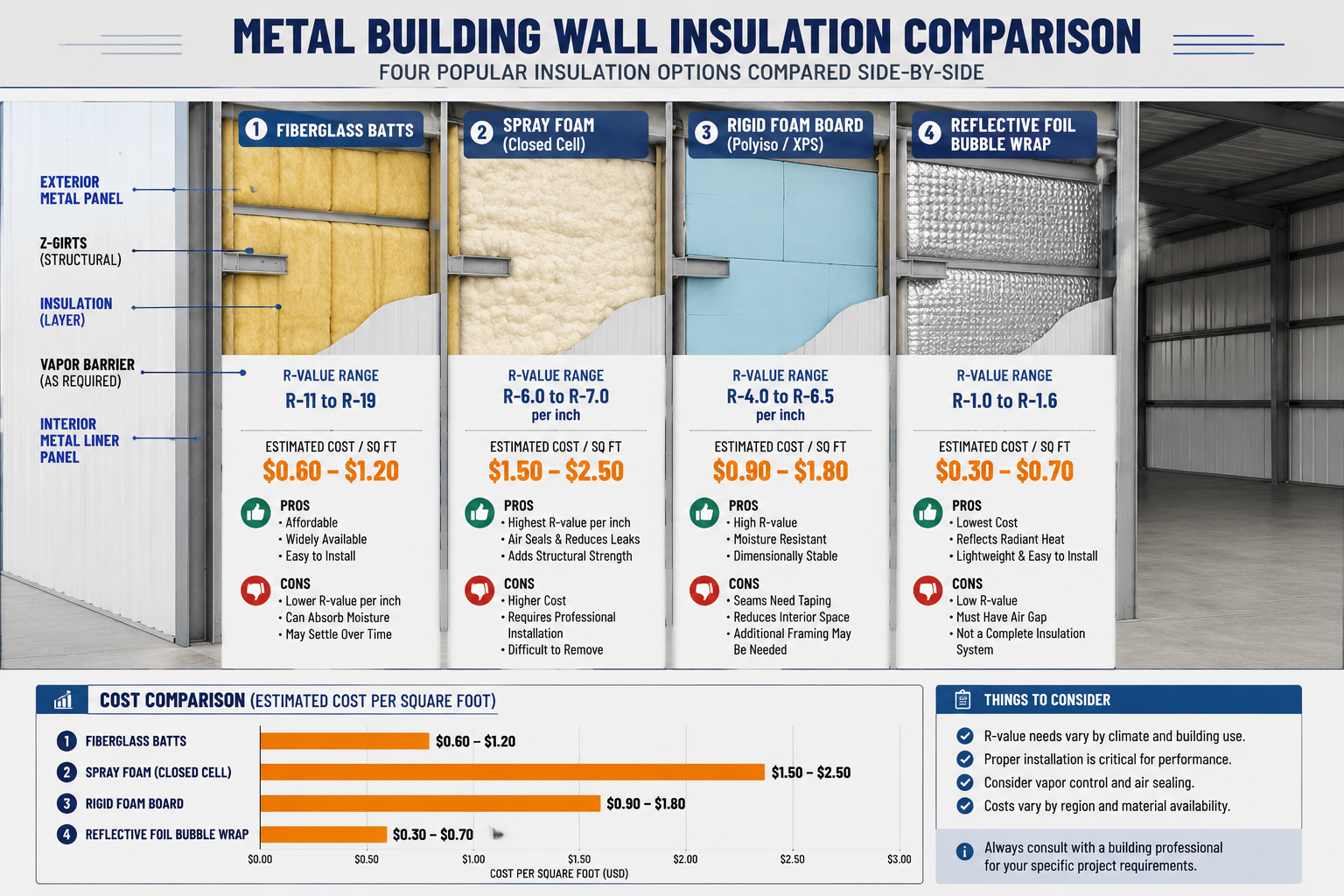
Each insulation type has a specific use case. Choosing the wrong one for a metal building can cause condensation problems, energy loss, or premature material failure.
Fiberglass Batt Insulation
Installed cost: $0.75–$1.50 per square foot
Fiberglass batts are the most widely used option for metal buildings because they are inexpensive and easy to install. They come in pre-cut widths designed to fit between metal framing members. The key limitation: fiberglass batts do not air-seal, so they must be paired with a proper vapor barrier (typically a reinforced foil facing) to prevent condensation on the metal skin.
- R-value range: R-11 to R-38 depending on thickness
- Best for: agricultural buildings, storage warehouses, budget-conscious projects
- DIY-friendly: Yes, with basic safety equipment
- Watch out for: compression during installation reduces R-value; gaps around framing members allow thermal bridging
Spray Polyurethane Foam (SPF)
Installed cost: $3.00–$7.00 per square foot
Spray foam is the premium choice for metal buildings. It adheres directly to the metal skin, eliminates air gaps, and acts as its own vapor barrier when applied at sufficient thickness. Closed-cell spray foam also adds structural rigidity to metal panels. The cost is high, but the performance gap over other options is real — especially in climates with extreme temperature swings.
- R-value range: R-3.7 per inch (open-cell) to R-6.5 per inch (closed-cell)
- Best for: conditioned spaces, shops, offices, cold storage, buildings in extreme climates
- DIY-friendly: No — requires licensed applicators and specialized equipment
- Watch out for: off-ratio mixing during application creates weak, crumbly foam; always verify contractor credentials
Rigid Foam Board
Installed cost: $1.25–$2.50 per square foot
Rigid foam board (polyisocyanurate, EPS, or XPS) is cut to fit between or over framing members and fastened mechanically. It performs well on walls and rooflines and can be layered to achieve target R-values. It does not conform to irregular surfaces, so gaps must be sealed with spray foam or tape.
- R-value range: R-3.8 to R-6.5 per inch depending on product type
- Best for: wall assemblies, roof decks, buildings with flat or simple geometries
- DIY-friendly: Yes, for experienced DIYers
- Watch out for: polyiso loses R-value in very cold temperatures; XPS or EPS may be a better choice in northern climates
Reflective / Radiant Barrier Insulation
Installed cost: $0.50–$1.25 per square foot
Reflective insulation (foil-faced bubble wrap or multi-layer foil products) works by reflecting radiant heat rather than absorbing it. It is most effective in hot, sunny climates where solar gain through the metal roof is the primary problem. It does very little to stop conductive heat loss in cold climates.
- R-value range: R-3 to R-17 (varies widely by product and installation method; claims can be misleading)
- Best for: hot climates, agricultural buildings, supplemental insulation layers
- DIY-friendly: Yes
- Watch out for: reflective insulation R-value claims are often tested under ideal conditions; real-world performance in cold climates is significantly lower
How Much Does It Cost to Insulate a Metal Building by Size?
The table below provides rough installed cost estimates for common metal building sizes using two popular insulation types: fiberglass batts (budget) and closed-cell spray foam (premium). These are estimates based on typical 2026 contractor pricing and assume standard wall and roof coverage.
| Building Size | Fiberglass Batts (Installed) | Closed-Cell Spray Foam (Installed) |
|---|---|---|
| 1,000 sq ft | $750 – $1,500 | $3,000 – $7,000 |
| 2,500 sq ft | $1,875 – $3,750 | $7,500 – $17,500 |
| 5,000 sq ft | $3,750 – $7,500 | $15,000 – $35,000 |
| 10,000 sq ft | $7,500 – $15,000 | $30,000 – $70,000 |
| 20,000 sq ft | $15,000 – $30,000 | $60,000 – $140,000 |
Note: These figures cover walls and roof only. They do not include slab insulation, door/window perimeters, or interior finishing. Actual quotes will vary based on local labor markets and site conditions.
What Is the Cheapest Way to Insulate a Metal Building?
The cheapest approach to insulating a metal building is a combination of fiberglass batt insulation with a foil-faced vapor barrier, installed by the building owner. This method can bring total costs down to $0.50–$0.90 per square foot in materials alone.
For a budget-conscious project, follow this approach:
- Install a vapor barrier first — use a reinforced foil-faced barrier stapled or clipped to the metal framing before placing batts.
- Use faced fiberglass batts — the kraft or foil facing adds a secondary moisture layer.
- Seal all seams and penetrations with foil tape or acoustical sealant.
- Add a reflective foil layer on the roof if you are in a hot climate — this is inexpensive and meaningfully reduces cooling loads.
- Skip interior finishing for non-conditioned spaces — exposed insulation is acceptable in warehouses and agricultural buildings.
Choose fiberglass batts if: your building is a warehouse, barn, or storage facility that does not need to be fully conditioned, and your primary goal is reducing temperature extremes rather than maintaining a precise indoor climate.
Choose spray foam if: your building will be used as a workshop, office, or any conditioned space where air quality, humidity control, and energy efficiency are priorities.
Does Insulating a Metal Building Actually Save Money?
Yes — and the payback period is often faster than most building owners expect. Metal buildings are notoriously poor thermal performers without insulation because metal is a highly conductive material. An uninsulated metal building can lose or gain heat 300 to 400 times faster than a wood-framed building with standard insulation, according to the Metal Building Manufacturers Association (MBMA).
While I cannot cite a specific verified study on exact payback periods for every climate zone, the general industry estimate for insulation payback in commercial metal buildings is 3–7 years, based on energy savings relative to installation cost. Buildings in extreme climates (very hot or very cold) tend to see faster payback.
Beyond energy savings, insulation provides:
- Condensation control, which prevents rust and structural damage to the metal frame
- Noise reduction, which matters for workshops and offices near roads or equipment
- Fire resistance improvement (closed-cell spray foam adds a degree of fire retardancy)
- Increased resale or lease value for commercial properties
What Are the Hidden Costs When Insulating a Metal Building?
The base insulation cost is only part of the total project budget. Several additional line items catch building owners off guard.
Vapor barrier: Required in most climates when using fiberglass batts. Cost: $0.10–$0.30 per square foot.
Framing and furring strips: Rigid foam board and some batt applications require wood or metal furring strips to create a cavity. Cost: $0.25–$0.75 per square foot.
Interior finish panels: Many insulated metal buildings require a liner panel or drywall to protect insulation and meet fire codes. Cost: $1.00–$3.00 per square foot for liner panels.
Permits: Depending on jurisdiction and building use, insulation work may require a building permit. Fees range from $150 to $1,500 or more for larger commercial projects.
Air sealing at penetrations: Every pipe, conduit, or anchor bolt that penetrates the metal skin is a thermal bypass. Sealing these properly adds labor time and material cost.
Removal of existing insulation: Older metal buildings may have deteriorated fiberglass or damaged foil that must be removed before new insulation is installed. Removal costs range from $0.25 to $0.75 per square foot.
How Do You Choose the Right Insulation for a Metal Building?
The right insulation choice depends on three questions: What will the building be used for? What climate zone is it in? What is the total budget?
Use this decision framework:
| Use Case | Climate | Best Insulation Choice |
|---|---|---|
| Warehouse / storage | Any | Fiberglass batts + vapor barrier |
| Agricultural / barn | Hot or mixed | Reflective foil + fiberglass batts |
| Workshop / garage | Cold (Zones 5–7) | Closed-cell spray foam or rigid foam |
| Conditioned office space | Any | Closed-cell spray foam |
| Cold storage / refrigeration | Any | Closed-cell spray foam (minimum 2 in.) |
| Retrofit of existing building | Any | Spray foam or rigid board (easier to fit) |
Edge case — partial insulation: Some building owners insulate only the roof and leave walls uninsulated to reduce cost. This makes sense for agricultural buildings in moderate climates but is rarely sufficient for conditioned spaces, where walls account for 30–40% of total heat transfer.
Should You Hire a Contractor or DIY the Insulation?
For fiberglass batts and reflective foil, DIY is a realistic option for building owners with basic construction skills. For spray foam, hiring a licensed contractor is almost always the right call.
DIY is reasonable when:
- You are installing fiberglass batts or reflective foil
- The building is a simple rectangular structure with accessible framing
- You have time to do the work properly (rushing leads to gaps and compression)
- The building does not require a permit or inspection
Hire a contractor when:
- You are using spray foam — improper mixing ratios create foam that fails within months
- The building will be used as a conditioned commercial space
- Local codes require inspected insulation
- The building has complex geometry, multiple penetrations, or existing damage
When getting contractor quotes, always ask for:
- The specific product brand and R-value being installed
- Whether the quote includes vapor barrier and air sealing
- Proof of contractor certification for spray foam (SPFA certification is the industry standard in the U.S.)
- A written warranty on both materials and labor
FAQ: Cost to Insulate a Metal Building
Q: What is the average cost per square foot to insulate a metal building?
Installed costs range from $0.75 to $7.00 per square foot depending on insulation type. Fiberglass batts average $0.75–$1.50 per square foot installed; closed-cell spray foam averages $3.00–$7.00 per square foot installed.
Q: How much does it cost to insulate a 40×60 metal building?
A 40×60 metal building has 2,400 square feet of floor area, but the insulated surface area (walls plus roof) is typically 4,000–5,000 square feet. Expect to pay $3,000–$7,500 for fiberglass batts or $12,000–$35,000 for spray foam, fully installed.
Q: Is spray foam worth the extra cost in a metal building?
For conditioned spaces, yes. Spray foam eliminates air infiltration and condensation risk in ways that fiberglass batts cannot. For unconditioned storage buildings, the premium is harder to justify.
Q: What R-value do I need for a metal building?
The U.S. Department of Energy recommends R-19 to R-38 for metal building roofs and R-13 to R-19 for walls, depending on climate zone. Colder climates (Zones 5–7) require the higher end of those ranges.
Q: Can I insulate a metal building from the outside?
Yes. Exterior continuous insulation (rigid foam board applied over the metal skin before cladding) is an effective method that eliminates thermal bridging through framing members. It is more common in new construction than retrofits.
Q: Does insulation prevent condensation in a metal building?
Yes, when installed correctly. The key is ensuring the insulation system includes a proper vapor barrier and that the dew point never occurs within the insulation layer. Spray foam is the most reliable solution because it eliminates air movement entirely.
Q: How long does metal building insulation last?
Fiberglass batts last 20–30 years if kept dry. Spray foam lasts 30+ years and does not degrade unless physically damaged. Reflective foil products typically last 10–25 years depending on product quality and installation.
Q: Do I need a permit to insulate a metal building?
It depends on local jurisdiction and building use. Commercial buildings and buildings with conditioned space typically require a permit. Agricultural and storage buildings in rural areas often do not. Always check with your local building department before starting work.
Q: What is the cheapest insulation for a metal building?
Fiberglass batts are the cheapest option, with materials available for $0.30–$0.80 per square foot. Reflective foil is similarly priced and easier to install in some applications.
Q: Can I add more insulation to an already-insulated metal building?
Yes. Adding a second layer of rigid foam board over existing fiberglass batts is a common upgrade. Spray foam can also be applied over existing insulation in some cases, though a contractor should assess the existing condition first.
Conclusion
The cost to insulate a metal building in 2026 spans a wide range — from under $1.00 per square foot for basic fiberglass batts to $7.00 or more for closed-cell spray foam. The right choice is not simply the cheapest one; it is the one that matches your building’s use, climate, and long-term cost goals.
Here are your actionable next steps:
- Define your use case first. Conditioned office or shop space demands spray foam or high-R rigid board. Storage and agricultural buildings can work well with fiberglass batts.
- Check your climate zone using the U.S. DOE’s climate zone map and identify the recommended R-values for your region before purchasing materials.
- Get at least three contractor quotes for any project over 2,000 square feet. Ask each contractor to specify the product, R-value, and whether vapor barrier and air sealing are included.
- Budget for the full system, not just insulation — add 25–40% to your base insulation estimate to cover vapor barriers, framing, permits, and any interior finish panels.
- Consider long-term payback. Spending more on spray foam in a conditioned building often pays back in 4–6 years through energy savings and avoided moisture damage repairs.
A well-insulated metal building is more comfortable, more energy-efficient, and more durable. The investment is almost always worth making — the only real question is which insulation system fits your specific situation.
References
- Metal Building Manufacturers Association (MBMA). Metal Building Systems Manual. MBMA, 2021. https://www.mbma.com
- U.S. Department of Energy. Insulation R-Value Recommendations by Climate Zone. Energy.gov, 2023. https://www.energy.gov/energysaver/insulation
- Spray Polyurethane Foam Alliance (SPFA). Contractor Certification Program Overview. SPFA, 2022. https://www.sprayfoam.org
- Oak Ridge National Laboratory. Thermal Performance of Building Envelope Details for Mid- and High-Rise Buildings. U.S. Department of Energy, 2020. https://www.ornl.gov