
Last updated: May 18, 2026
Quick Answer
Metal buildings typically cost $15 to $25 per square foot for the steel kit alone, while wood frame construction runs $20 to $35 per square foot for framing materials and labor in most U.S. regions (estimates based on 2025–2026 contractor surveys and industry pricing data). However, the total project cost depends heavily on building size, location, intended use, and long-term ownership expenses. Neither material is universally cheaper — the right choice depends on your specific project scope and timeline.
Key Takeaways
- Metal buildings generally have lower upfront material costs for large, open-span structures like warehouses, garages, and agricultural buildings.
- Wood frame construction is often more cost-competitive for smaller residential projects, custom layouts, and buildings requiring significant interior finishing.
- Long-term costs favor metal in most cases, due to lower maintenance, better pest resistance, and longer lifespan.
- Wood frame buildings offer more design flexibility and are easier to modify after construction, which matters for retail, office, and residential use.
- Labor costs differ significantly: metal building erection requires specialized crews, while wood framing draws from a larger, more widely available labor pool.
- Insurance premiums are typically lower for metal buildings due to fire and wind resistance, which affects 20-year total cost of ownership.
- Permitting and foundation requirements are similar for both construction types and should not be overlooked in any budget.
- Climate and local building codes can shift the cost equation — cold climates may require additional insulation for metal buildings, adding cost.
- For agricultural and industrial use, metal buildings deliver the strongest cost-per-square-foot value at larger scales (5,000+ sq ft).
- Always compare total cost of ownership, not just construction cost, before making a final decision.
What Is the Core Difference in Metal Building Cost vs Wood Frame Cost?
The core difference comes down to materials, labor specialization, and long-term maintenance. Metal buildings use pre-engineered steel components manufactured off-site, while wood frame buildings use dimensional lumber assembled on-site by conventional framing crews.
For a standard 40×60 ft (2,400 sq ft) structure:
| Cost Category | Metal Building (Est.) | Wood Frame (Est.) |
|---|---|---|
| Materials (kit or lumber) | $18,000–$36,000 | $22,000–$48,000 |
| Foundation | $8,000–$15,000 | $8,000–$15,000 |
| Erection/Framing Labor | $10,000–$20,000 | $12,000–$22,000 |
| Insulation | $4,000–$10,000 | $3,000–$8,000 |
| Interior Finishing (basic) | $5,000–$15,000 | $6,000–$18,000 |
| Estimated Total | $45,000–$96,000 | $51,000–$111,000 |
These are rough estimates for a basic, unfinished utility structure. Actual costs vary by region, contractor, and specifications. Always obtain local quotes.
Key point: The foundation cost is nearly identical for both construction types, so it should not factor into your material comparison. The real savings with metal come from faster erection time and lower material waste.
How Do Material Costs Compare Between Metal and Wood Frame Buildings?
Metal building material costs are generally more predictable because steel kits are factory-fabricated to spec. Wood frame material costs are more volatile because lumber prices fluctuate significantly with market conditions.
Metal building materials include:
- Pre-engineered steel primary and secondary framing
- Metal roof and wall panels (often included in kit price)
- Fasteners, trim, and flashing
- Doors and windows (usually quoted separately)
Wood frame materials include:
- Dimensional lumber (2×4, 2×6, engineered beams)
- Plywood or OSB sheathing
- Roofing materials (separate from framing)
- Insulation, vapor barriers, and housewrap
💡 Pull quote: “Lumber prices swung by more than 300% between 2020 and 2022, according to the U.S. Bureau of Labor Statistics Producer Price Index data. Steel prices are volatile too, but pre-engineered metal building kits tend to lock in pricing at order time, giving buyers more budget certainty.”
Common mistake: Many buyers compare only the steel kit price to the lumber cost without accounting for roofing, siding, and trim — all of which are included in most metal building kit quotes but are separate line items for wood frame projects.
Where Does Labor Cost Fit Into the Metal Building Cost vs Wood Frame Cost Equation?
Labor is often the deciding factor in total project cost, and it favors metal buildings for large, simple structures. Metal building erection is faster because components are pre-cut and pre-drilled, but it requires a specialized crew familiar with steel assembly.
Labor comparison at a glance:
- Metal building erection: A 40×60 ft structure can typically be erected in 3–5 days by a 4-person crew. Labor cost estimates range from $4 to $8 per square foot depending on region.
- Wood frame construction: The same footprint takes 1–3 weeks for framing alone. Labor cost estimates range from $5 to $10 per square foot for framing.
Choose metal if: You need a large, open-span structure (warehouse, barn, equipment storage) and want to minimize time on-site.
Choose wood if: Your project requires complex interior layouts, multiple stories, or you’re in an area with limited access to metal building erection crews.
One edge case worth noting: in rural areas, finding a qualified metal building erection crew can be harder than finding conventional framers. This can flip the labor cost advantage.
What Are the Long-Term Cost Differences Between Metal and Wood Frame Buildings?
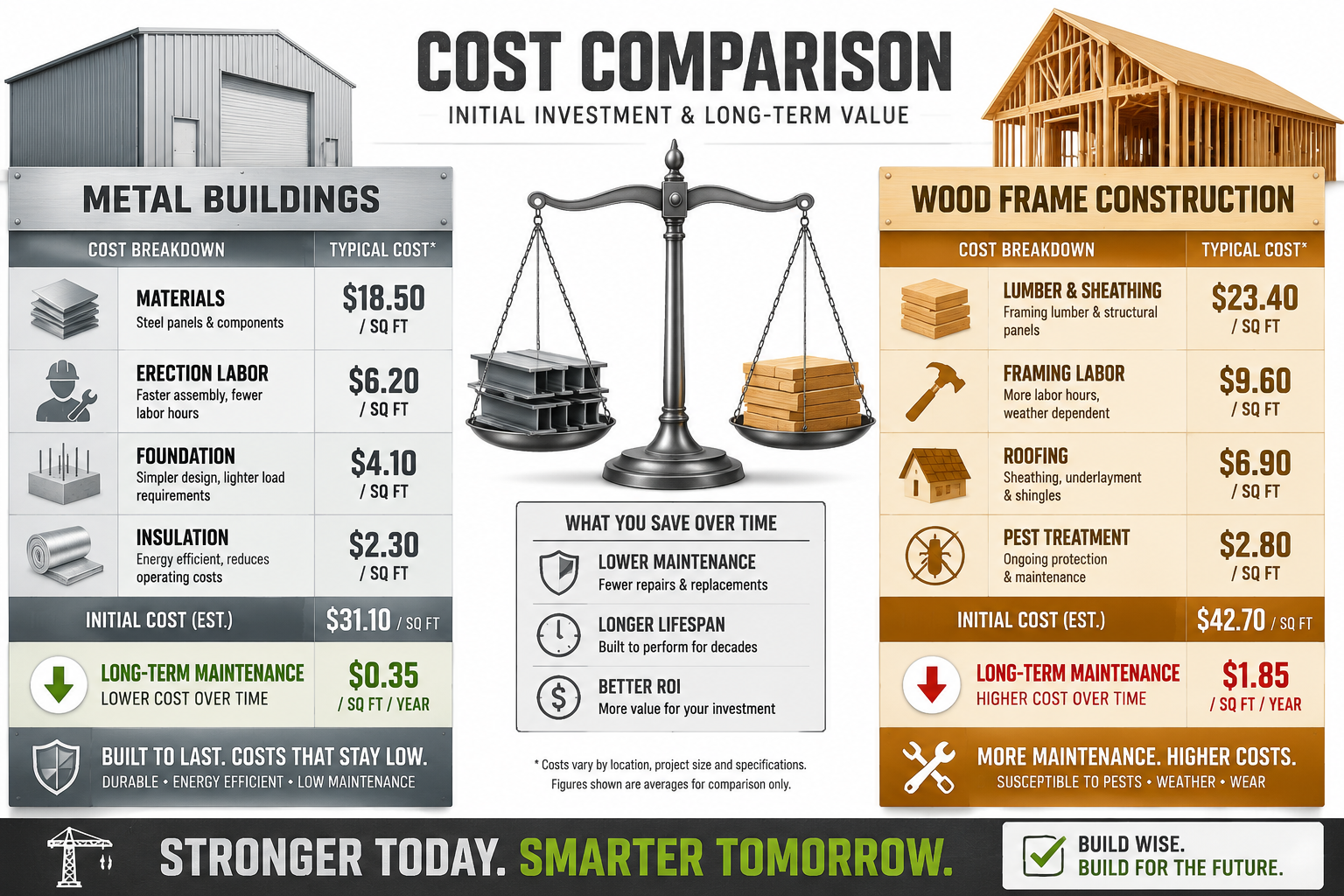
Over a 20–30 year ownership period, metal buildings typically cost less to maintain. This is one of the most important factors when evaluating metal building cost vs wood frame cost, and it’s often underweighted by first-time buyers.
Long-term cost factors:
| Factor | Metal Building | Wood Frame |
|---|---|---|
| Pest damage (termites, rodents) | Minimal risk | Moderate to high risk |
| Rot and moisture damage | Low risk | Moderate risk without proper maintenance |
| Repainting/refinishing | Every 15–25 years (metal panels) | Every 5–10 years (painted wood) |
| Roof replacement | 40–60 year lifespan (steel roofing) | 20–30 years (asphalt shingles) |
| Insurance premiums | Generally lower | Generally higher |
| Structural repairs | Rare | More common over time |
Decision rule: If you plan to own the building for more than 15 years, the lower maintenance costs of metal construction will likely offset any higher upfront costs. For short-term or temporary structures, wood frame may be more economical.
How Does Building Size Affect the Metal vs Wood Frame Cost Comparison?
Building size has a direct impact on which construction type delivers better value. Metal buildings become increasingly cost-competitive as square footage increases.
For small structures (under 1,000 sq ft), wood frame is often cheaper because:
- Small steel kits have relatively high per-unit fabrication costs
- Wood framing is faster and simpler at small scale
- Local contractors are more familiar with wood, reducing labor costs
For large structures (3,000 sq ft and above), metal buildings typically win on cost because:
- Steel’s open-span capability eliminates the need for interior load-bearing walls
- Larger kit orders reduce per-square-foot material cost
- Erection time scales efficiently with crew size
Practical example: A 10,000 sq ft metal warehouse can often be built for 15–25% less per square foot than the equivalent wood frame structure, primarily because of material efficiency and faster erection. (This is a general industry estimate; actual savings vary by market.)
What Hidden Costs Should You Watch for When Comparing Metal and Wood Frame Buildings?
Both construction types carry hidden costs that aren’t always obvious in initial quotes. Missing these can blow your budget.
Metal building hidden costs:
- Concrete slab anchoring: Metal buildings require anchor bolts set precisely in the slab. Errors are expensive to fix.
- Insulation upgrades: Standard metal panels have poor thermal performance. Spray foam or rigid board insulation adds $2–$6 per square foot.
- Condensation control: Without proper insulation and vapor barriers, metal buildings can develop serious condensation problems.
- Delivery and freight: Steel kits are heavy. Freight from the manufacturer can add $2,000–$8,000 depending on distance.
- Permits and engineering stamps: Most jurisdictions require stamped drawings for metal buildings, which adds $500–$2,500.
Wood frame hidden costs:
- Lumber price escalation: If your project timeline extends, lumber prices may rise between quote and purchase.
- Pest treatment: Termite pre-treatment and ongoing prevention adds cost in many regions.
- Moisture management: Improper flashing, housewrap, or drainage details lead to rot and mold remediation costs.
- Longer construction timeline: More time on-site means more exposure to weather delays and extended contractor overhead.
Common mistake: Buyers often compare a “turnkey” metal building quote to a “materials only” wood frame estimate. Make sure you’re comparing apples to apples — both quotes should include materials, labor, foundation, and finishing to the same specification level.
Which Construction Type Is Better for Specific Use Cases?
The best construction type depends on what the building will be used for. Here’s a direct breakdown:
Metal buildings are the better choice for:
- 🏭 Warehouses and distribution centers
- 🚜 Agricultural storage (hay barns, equipment sheds)
- 🔧 Auto repair shops and garages
- ✈️ Aircraft hangars
- 🏋️ Gyms and recreational facilities with large open spans
Wood frame buildings are the better choice for:
- 🏠 Residential homes and custom housing
- 🏪 Retail spaces requiring extensive interior customization
- 🏢 Multi-story office buildings
- 🏫 Schools and churches with complex architectural requirements
- Any project where local zoning or HOA rules restrict metal construction
Mixed approach: Some builders use a metal building shell (roof and exterior walls) with wood frame interior partitions. This hybrid method can reduce cost while maintaining design flexibility. It’s increasingly common for retail and light commercial projects.
How Do Financing and Insurance Costs Differ Between Metal and Wood Frame?
Financing and insurance are often overlooked in the metal building cost vs wood frame cost comparison, but they affect total project affordability.
Insurance:
Metal buildings typically qualify for lower property insurance premiums because they carry better ratings for fire resistance, wind resistance, and pest damage. In hurricane-prone or wildfire-risk areas, the insurance savings can be substantial over a 20-year period. (Contact your insurance provider for specific rate comparisons in your region, as rates vary significantly by location and insurer.)
Financing:
- Both construction types qualify for standard commercial construction loans.
- Metal building kits can sometimes be financed through the manufacturer, which may offer competitive rates for qualified buyers.
- Wood frame construction draws from a larger pool of lenders familiar with the construction type, which can simplify the loan process.
- Appraisal values for completed metal buildings have historically been lower than equivalent wood frame structures in residential contexts, which can affect refinancing options.
Decision rule: If the building will be used commercially or agriculturally, metal’s insurance advantages are significant. If the building will be appraised as residential real estate, wood frame typically appraises higher, which matters for resale and refinancing.
What Are the Environmental and Sustainability Cost Factors?
Sustainability affects both upfront cost and long-term value. Steel is one of the most recycled materials in the world, while wood is a renewable resource — but the full picture is more nuanced.
Steel/metal buildings:
- Steel contains a high percentage of recycled content (often 25–90% recycled steel, per the American Iron and Steel Institute)
- Metal buildings generate minimal on-site waste because components are pre-cut
- Energy efficiency requires investment in insulation, which adds cost but reduces operating expenses
Wood frame buildings:
- Wood is renewable, but sourcing matters (look for FSC-certified lumber)
- Wood construction generates more on-site waste
- Wood has natural insulating properties, reducing some insulation costs
From a pure cost standpoint, the sustainability differences don’t dramatically change the metal building cost vs wood frame cost equation for most buyers. However, if your project qualifies for green building incentives or energy efficiency tax credits, the insulation investment in a metal building can generate measurable returns.
FAQ: Metal Building Cost vs Wood Frame Cost
Q: Is a metal building always cheaper than wood frame construction?
No. Metal buildings are generally cheaper for large, simple structures like warehouses and barns. For small residential or highly customized commercial buildings, wood frame is often more cost-competitive.
Q: How long does it take to build a metal building compared to wood frame?
A metal building shell can typically be erected in days to weeks, while a comparable wood frame structure takes weeks to months. Faster construction reduces labor costs and financing carrying costs.
Q: Do metal buildings hold their value as well as wood frame buildings?
In commercial and agricultural contexts, metal buildings hold value well. In residential real estate markets, wood frame structures typically appraise higher, which can affect resale value.
Q: Can I build a metal building myself to save money?
Some manufacturers sell DIY metal building kits. Basic structures can be assembled by experienced DIYers, but most jurisdictions require professional installation for permit approval and structural warranty compliance.
Q: What is the lifespan of a metal building vs a wood frame building?
A well-maintained metal building can last 50+ years. A well-maintained wood frame building can also last 50–100+ years, but requires more active maintenance to achieve that lifespan.
Q: Are metal buildings harder to insulate than wood frame?
Yes, standard metal panels have poor thermal performance. Proper insulation (spray foam, rigid board, or batt insulation with vapor barrier) is essential and adds $2–$6 per square foot to the project cost.
Q: Which construction type is better in high-wind or hurricane zones?
Pre-engineered metal buildings are often engineered to meet high wind load requirements and can be more cost-effective in hurricane zones when properly designed. Always verify wind load ratings with the manufacturer and local building department.
Q: Does a metal building require a different foundation than wood frame?
Both types typically require a concrete slab or perimeter foundation. Metal buildings require precisely placed anchor bolts, which demands careful coordination between the foundation contractor and the building manufacturer.
Q: What is the average cost per square foot for a metal building in 2026?
For a basic, unfinished metal building shell, expect $15–$40 per square foot depending on size, region, and specifications. Finished, climate-controlled metal buildings can run $50–$100+ per square foot.
Q: Can I add onto a metal building later?
Yes, but additions require careful planning. Expanding a metal building typically means ordering additional engineered components from the original manufacturer, which can be more complex than adding onto a wood frame structure.
Q: Which type is better for a residential shop or garage?
For a detached residential garage or workshop under 1,500 sq ft, wood frame is often more cost-effective and easier to permit. Metal becomes more competitive above 2,000–3,000 sq ft.
Q: How do I get an accurate cost comparison for my specific project?
Get at least three quotes from both metal building suppliers and local general contractors for wood frame construction. Specify the same footprint, use, insulation level, and finish quality in each quote to ensure a valid comparison.
Conclusion: Making the Right Choice for Your Project
The metal building cost vs wood frame cost comparison doesn’t have a single universal answer — it has a right answer for your specific project. Here’s how to reach it.
Actionable next steps:
- Define your use case first. Large agricultural, industrial, or commercial structures favor metal. Residential and highly customized commercial projects favor wood frame.
- Calculate total cost of ownership, not just construction cost. Factor in maintenance, insurance, and energy costs over your expected ownership period.
- Get parallel quotes. Request quotes from at least two metal building manufacturers and two general contractors for wood frame construction, using identical specifications.
- Check local building codes and zoning. Some municipalities restrict metal buildings in certain zones. Confirm before you commit.
- Account for site-specific factors. Soil conditions, climate, freight distance from steel manufacturers, and local labor availability all affect the final cost equation.
- Consider the hybrid approach. A metal shell with wood frame interior partitions can deliver cost savings while maintaining design flexibility — worth discussing with your contractor.
For most buyers evaluating metal building cost vs wood frame cost in 2026, the decision comes down to this: if you need a large, durable, low-maintenance structure and design flexibility is secondary, metal wins. If you need a building that appraises well as real estate, accommodates complex interior layouts, or falls under 2,000 sq ft, wood frame is likely the smarter investment.
References
- American Iron and Steel Institute. (2023). Steel Recycling Rates. https://www.steel.org/steel-markets/construction/
- U.S. Bureau of Labor Statistics. (2022). Producer Price Index: Lumber and Wood Products. https://www.bls.gov/ppi/
- Metal Building Manufacturers Association (MBMA). (2023). Metal Building Systems Manual. https://www.mbma.com
- National Association of Home Builders (NAHB). (2024). Construction Cost Survey. https://www.nahb.org
- Forest Stewardship Council (FSC). (2023). FSC Certified Lumber Standards. https://us.fsc.org