

Quick Answer: Building a barndominium on a budget is achievable for most owner-builders willing to plan carefully, source affordable materials, and take on some labor themselves. Costs typically range from $50 to $150 per square foot depending on location, finish level, and how much work you self-perform, compared to $150 to $250 or more for a traditionally built home. With the right strategy, a modest barndominium can be completed for under $150,000 in many rural U.S. markets.
Key Takeaways
- A barndominium is a metal or steel-frame structure that combines living quarters with open workshop or storage space, and it typically costs 20 to 40 percent less per square foot than a conventional stick-built home.
- The biggest budget levers are land cost, shell kit selection, and how much labor you self-perform.
- Prefabricated steel building kits from suppliers like General Steel or Mueller Buildings can cut material costs significantly compared to custom fabrication.
- Rural land in the South and Midwest offers the lowest per-acre prices and the most permissive zoning for barndominium construction.
- Owner-builders who handle framing, insulation, and finish work can save $30,000 to $60,000 or more on a 1,500-square-foot build (estimate based on average contractor labor rates in rural markets, 2024).
- Common budget-busting mistakes include underestimating site prep costs, skipping soil testing, and choosing a remote lot without utility access.
- Financing a barndominium requires lenders who understand agricultural or non-traditional construction loans; not all conventional lenders will approve these projects.
- Building permits and codes vary widely by county, and some rural areas have minimal requirements that reduce compliance costs.
What Exactly Is a Barndominium and How Is It Different from a Regular House
A barndominium is a residential structure built on a steel or post-frame shell, originally designed for agricultural use, that has been converted or purpose-built to include full living quarters. Unlike a traditional stick-built home, which uses dimensional lumber framing, a barndominium relies on metal framing or post-and-beam construction for its structural envelope.
The practical differences matter for budget builders:
- Construction speed: A barndominium shell can be erected in days rather than weeks, reducing labor costs and weather exposure during the build.
- Open floor plans: The structural system eliminates many load-bearing interior walls, giving owners flexibility to design large, open living spaces without expensive engineering workarounds.
- Durability: Metal frames resist termites, rot, and fire more effectively than wood, which can lower long-term maintenance costs.
- Aesthetic: Modern barndominiums range from purely utilitarian to architecturally striking, with large windows, vaulted ceilings, and high-end finishes.
The key distinction from a regular house is the structural system. A barndominium is not a converted barn. It is a purpose-designed hybrid structure, and that distinction matters for permitting, financing, and appraisal.
How Much Does It Really Cost to Build a Barndominium Compared to a Traditional Home
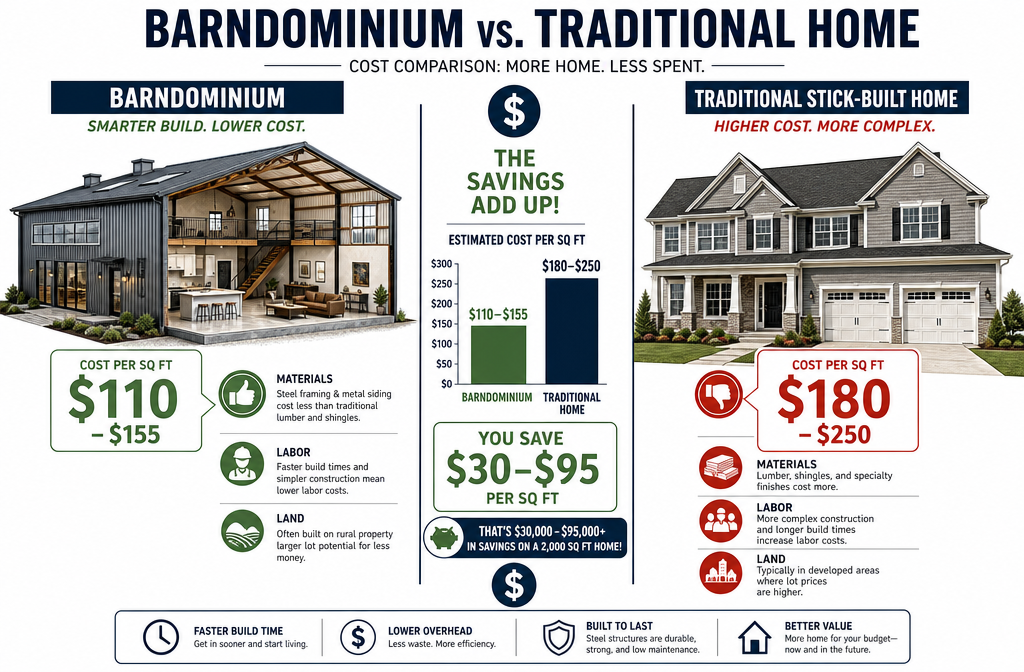
For most budget-conscious builders in 2026, a barndominium costs between $50 and $150 per square foot to build, depending on finish level and region. A comparable stick-built home in the same market typically runs $150 to $250 per square foot or higher. That gap represents real savings of tens of thousands of dollars on a modestly sized home.
Here is a rough cost breakdown for a 1,500-square-foot barndominium in a rural Midwest or Southern market:
| Cost Category | Estimated Range |
|---|---|
| Land (5 acres, rural) | $20,000 – $60,000 |
| Site prep and foundation | $15,000 – $35,000 |
| Steel shell / kit | $20,000 – $45,000 |
| Insulation | $5,000 – $12,000 |
| Electrical and plumbing | $18,000 – $35,000 |
| Interior finish (DIY-assisted) | $20,000 – $40,000 |
| HVAC | $8,000 – $18,000 |
| Total estimate | $106,000 – $245,000 |
The wide range reflects the single most important variable: how much work you do yourself. Owner-builders who handle insulation, drywall, painting, and finish carpentry can push toward the lower end. Those who hire out every trade will approach the upper end or exceed it.
Common mistake: Many first-time builders focus on the shell cost and forget that site preparation, including clearing, grading, septic installation, and well drilling, can easily add $30,000 to $60,000 before a single steel beam goes up.
Where Can I Find Affordable Land to Build My Barndominium
Affordable land for barndominium construction is most commonly found in rural counties across the South, Midwest, and parts of the Mountain West. States like Texas, Oklahoma, Arkansas, Missouri, and Tennessee consistently offer rural acreage at prices well below the national average, with fewer zoning restrictions on non-traditional residential structures.
Practical strategies for finding low-cost land:
- Search county tax auction listings. Properties with delinquent taxes are often sold at significant discounts through county treasurer offices.
- Use land-specific listing platforms such as LandWatch, Land And Farm, or Lands of America rather than general real estate sites.
- Target counties without zoning. Many rural counties in Texas, for example, have no county-level zoning, which means fewer restrictions on what you can build.
- Consider seller financing. Private landowners in rural areas sometimes offer owner-financed deals with lower down payments than traditional lenders require.
Decision rule: Choose land at least 10 to 20 acres if your budget allows. Larger parcels in rural markets often cost only marginally more per transaction than smaller lots, and the extra acreage protects your investment and provides space for outbuildings.
One important caution: always verify utility access before purchasing. A lot priced at $15,000 may require $40,000 in well drilling, septic installation, and electrical line extension to become buildable.
What Are the Cheapest Materials to Use for a Budget Barndominium
The most cost-effective material strategy for a budget barndominium centers on a prefabricated steel shell, spray foam or rigid board insulation, and modest interior finishes chosen for durability rather than luxury.
Shell and framing:
- Prefabricated steel building kits are the backbone of budget barndominium construction. Suppliers like Mueller Buildings, General Steel, and Worldwide Steel Buildings offer engineered kits that include framing, roofing panels, and wall panels.
- Post-frame (pole barn) construction is often even cheaper than rigid steel frame and works well in rural areas with permissive codes.
Insulation:
- Spray polyurethane foam (closed-cell) is the gold standard for metal buildings because it eliminates condensation and air infiltration, but it costs more upfront.
- Rigid foam board combined with a vapor barrier is a lower-cost alternative that still performs well in most climates.
Interior finishes:
- Polished concrete floors cost far less than tile or hardwood and require minimal maintenance.
- Shiplap or OSB wall panels finished with paint are far cheaper than drywall in large open spaces.
- Metal roofing on the shell doubles as the finished roof, eliminating the need for a separate roofing contractor.
What to avoid: Cutting corners on insulation is one of the most expensive long-term mistakes a budget builder can make. A poorly insulated metal building becomes nearly unlivable in summer heat or winter cold, and retrofitting insulation after the fact costs far more than doing it correctly during construction.
Can I Do Some of the Construction Myself to Save Money
Yes, and for most budget builders, self-performing labor is the single most powerful tool for keeping costs down when learning how to build a barndominium on a budget. The key is knowing which tasks are genuinely DIY-friendly and which require licensed professionals.
Tasks most owner-builders can handle:
- Site clearing and basic grading (with rented equipment)
- Concrete slab preparation and forming (though pouring is often best hired out)
- Steel kit assembly with a small crew (manufacturers provide detailed instructions)
- Insulation installation (rigid board or batt)
- Interior framing of non-structural walls
- Drywall hanging and finishing (with practice)
- Painting, trim, and finish carpentry
- Landscaping and gravel work
Tasks that typically require licensed contractors:
- Electrical wiring and panel installation (required by code in most jurisdictions)
- Plumbing rough-in and connections to well or municipal supply
- HVAC installation and refrigerant handling
- Septic system design and installation
Edge case: Some states allow owner-builders to pull their own electrical and plumbing permits without a license, provided they intend to occupy the structure. Check your specific county or state rules before assuming you can self-perform these trades.
Are There Prefab or Kit Options That Are More Affordable
Prefabricated barndominium kits are among the most budget-friendly starting points for this type of build. Several manufacturers sell engineered steel building packages that include all structural components, fasteners, and roofing materials, delivered to your site.
Notable kit suppliers (as of 2026):
- Mueller Buildings (Texas-based, strong dealer network in the South)
- General Steel (national reach, customizable designs)
- Worldwide Steel Buildings (competitive pricing, ships nationwide)
- Ameribuilt Steel (budget-focused, basic designs)
A basic 40×60 steel shell kit (2,400 square feet of footprint) can range from $25,000 to $55,000 depending on the supplier, wall height, and included features. That shell cost does not include foundation, insulation, or interior buildout.
Decision rule: Choose a kit if you want faster construction timelines, predictable material costs, and engineered drawings that simplify the permit process. Choose custom fabrication only if your design requirements cannot be met by standard kit dimensions.
What States or Regions Are Best for Budget Barndominium Construction
The most cost-effective states for barndominium construction in 2026 are Texas, Oklahoma, Arkansas, Missouri, Tennessee, and Alabama. These states share several characteristics that favor budget builds: low land prices, permissive rural zoning, lower contractor labor rates, and established local familiarity with post-frame and metal building construction.
Why Texas leads the list:
- Many rural Texas counties have no county-level zoning.
- A large network of local steel building contractors keeps competition and prices healthy.
- No state income tax, which helps overall cost of living during a multi-year build.
States to approach with caution:
- California, New York, and Massachusetts have strict energy codes, high labor costs, and complex permitting that can erase the cost advantage of barndominium construction.
- Coastal or flood-prone areas add foundation engineering costs that significantly raise the budget.

What Building Codes or Permits Do I Need to Watch Out For
Building codes and permit requirements for barndominiums vary dramatically by jurisdiction. In unincorporated rural counties, you may face minimal requirements. In incorporated towns or counties with active planning departments, you may encounter the same code requirements as any residential construction project.
Key permit categories to research before buying land:
- Residential occupancy permit: Some counties do not permit metal buildings for full-time residential use without specific approvals.
- Energy code compliance: Many states have adopted the International Energy Conservation Code (IECC), which sets minimum insulation and window performance standards.
- Septic and well permits: These are typically issued by the county health department and have their own inspection requirements.
- Fire and safety codes: If your barndominium includes a workshop or garage space, fire separation requirements between living and non-living areas may apply.
Practical step: Before purchasing land, call the county building department and ask two specific questions: “Do you permit metal or post-frame structures for residential occupancy?” and “What is the permit fee schedule for a new residential build?” The answers will tell you quickly whether the jurisdiction is budget-friendly.
How Do I Get Financing for a Budget Barndominium Build
Financing a barndominium is more complex than getting a conventional mortgage, but it is far from impossible. The key is finding lenders who specialize in agricultural, rural, or non-traditional construction lending.
Financing options for barndominium builders:
- USDA Rural Development loans: The USDA Section 502 Direct and Guaranteed loan programs can finance barndominiums in eligible rural areas, provided the structure meets residential habitability standards.
- Farm Credit System lenders: Institutions like AgriFinancial or local Farm Credit offices frequently finance barndominiums because they understand rural property types.
- Construction-to-permanent loans: Some regional banks and credit unions offer these loans, which convert to a standard mortgage once construction is complete.
- Owner-builder loans: A small number of lenders offer loans specifically for owner-builders, though they typically require demonstrated construction experience or a licensed general contractor overseeing the project.
Common mistake: Approaching a large national bank first. Most major lenders use automated underwriting systems that flag non-standard construction types. Start with local community banks, credit unions, or Farm Credit lenders who make manual underwriting decisions.
What Size Barndominium Can I Realistically Build for Under $100,000
A barndominium of 800 to 1,200 square feet of finished living space is achievable for under $100,000 in low-cost rural markets, provided you own the land outright, handle significant labor yourself, and choose modest finishes. This estimate assumes rural Texas, Oklahoma, or Arkansas pricing as of 2026 and does not include land acquisition.
A realistic $90,000 build scenario (owner-builder, rural South):
- 30×40 steel shell kit: $18,000
- Concrete slab (hired out): $12,000
- Site prep and septic: $20,000
- Spray foam insulation (DIY-assisted): $8,000
- Electrical and plumbing (licensed contractors): $22,000
- Interior finishes (DIY): $10,000
- Total: approximately $90,000
This scenario requires the builder to own the land, self-perform a significant portion of interior work, and accept a modest finish level. Anyone expecting granite countertops, custom cabinetry, or high-end fixtures will need a larger budget.
What Are the Most Common Mistakes People Make When Trying to Build a Cheap Barndominium
Understanding how to build a barndominium on a budget also means understanding where budgets collapse. The following mistakes account for the majority of cost overruns in barndominium projects.
- Skipping soil testing. Poor soil can require expensive foundation engineering changes that add $10,000 to $30,000 to the project.
- Buying remote land without utility access. Well drilling, septic, and electrical line extension costs are frequently underestimated.
- Underestimating site preparation. Clearing, grading, and road access can cost more than the steel shell in heavily wooded or uneven terrain.
- Choosing a jurisdiction with restrictive codes late in the process. Discovering that your county requires full residential code compliance after purchasing land is an expensive surprise.
- Skimping on insulation. A metal building without proper insulation creates condensation, mold, and energy bills that dwarf the upfront savings.
- Not getting multiple contractor bids. In rural markets, pricing for trades like plumbing and electrical varies widely. Getting three bids routinely saves 15 to 25 percent.
- Scope creep. Adding square footage, upgraded finishes, or additional outbuildings mid-project is the fastest way to blow a budget.
FAQ
Is a barndominium cheaper to build than a regular house?
Yes, in most rural markets. Barndominiums typically cost $50 to $150 per square foot to build, compared to $150 to $250 or more for a conventionally framed home in the same area. The savings come primarily from faster construction, less labor-intensive framing, and lower material costs for the structural shell.
Do barndominiums hold their value?
Barndominium resale values vary by market. In rural areas where they are common, they appraise and sell comparably to other rural residential properties. In suburban or urban markets, appraisers may struggle to find comparable sales, which can suppress appraised value.
Can I get a regular mortgage on a barndominium?
Not easily through conventional lenders. Most barndominium buyers use USDA loans, Farm Credit lenders, or construction-to-permanent loans from community banks. Fannie Mae and Freddie Mac guidelines generally do not accommodate non-standard construction types.
How long does it take to build a barndominium?
A basic barndominium shell can be erected in one to two weeks. Full completion, including interior buildout, typically takes six to eighteen months depending on contractor availability, owner-builder involvement, and permit timelines.
Are barndominiums good for people with limited construction experience?
They can be, particularly for the shell assembly phase, which is more straightforward than stick framing. However, limited experience increases the risk of costly mistakes in insulation, moisture management, and interior systems. Partnering with an experienced general contractor as an advisor, even if you self-perform most work, is a sound investment.
What is the minimum acreage I need for a barndominium?
There is no universal minimum, but most rural counties that permit barndominiums require at least one to two acres for septic system setbacks. Five or more acres is a practical target for flexibility and resale appeal.
Can I live in my barndominium while it is being built?
In some cases, yes. Some builders erect the shell and make a portion livable while finishing the rest. This depends on local occupancy permit rules and your tolerance for construction conditions.
Do I need an architect for a barndominium?
Not necessarily. Many steel kit suppliers provide engineered drawings that satisfy permit requirements. However, if you are making significant custom modifications or building in a jurisdiction with strict residential codes, an architect or structural engineer may be required.
What is the best foundation for a budget barndominium?
A monolithic concrete slab is the most common and cost-effective foundation choice for barndominiums in most climates. Pier-and-beam foundations are used in areas with expansive clay soils or where the slab cost is prohibitive.
Are there HOA restrictions on barndominiums?
Many HOAs prohibit metal buildings or non-traditional residential structures. Always check HOA covenants before purchasing land in any planned community or subdivision.
Conclusion
Learning how to build a barndominium on a budget is as much about planning and research as it is about construction. The builders who succeed are those who choose their land carefully, understand their local permit environment before breaking ground, select a prefabricated kit that fits their footprint, and self-perform as much labor as their skills allow.
Actionable next steps for 2026:
- Research three to five rural counties in your target state and call each building department to confirm barndominium permitting.
- Get soil test quotes for any land you are seriously considering before making an offer.
- Request pricing from at least three steel kit suppliers for your target square footage.
- Contact a Farm Credit lender or local community bank to discuss construction loan pre-qualification.
- Build a detailed line-item budget that includes site prep, utilities, and a 15 percent contingency reserve before committing to any land purchase.
A well-planned barndominium is one of the most cost-effective paths to homeownership available in rural America today. The savings are real, the lifestyle is genuinely appealing, and the construction process is more accessible to motivated owner-builders than almost any other housing type. Start with the land, respect the budget, and build with a clear plan.
Sources
- USDA Rural Development. “Single Family Housing Programs.” USDA.gov. 2023. https://www.rd.usda.gov/programs-services/single-family-housing-programs
- Farm Credit System. “About Farm Credit.” FarmCredit.com. 2024. https://www.farmcredit.com/about
- International Code Council. “International Energy Conservation Code (IECC).” ICC. 2021. https://www.iccsafe.org/products-and-services/i-codes/2021-i-codes/iecc/
- LandWatch. “Rural Land Listings.” LandWatch.com. 2024. https://www.landwatch.com
- Mueller Buildings. “Steel Building Kits.” MuellerInc.com. 2024. https://www.muellerinc.com
